Showing posts with label Bork family. Show all posts

Thursday, May 29, 2014

Per Gustaf Bork – blacksmith and narrow gauge pioneer


When the Skyllberg Iron Works planned to introduce steam power on their railroad in 1881, master mechanic Olaus Bork (see “A railroad builder in the family” ) did not have to go far for advice. Since 1875 his younger brother Per Gustaf Bork was employed as a locomotive engineer, and later master mechanic at the Hjo – Stenstorp Railroad (HSJ).

Per Gustaf was born in 1844 at Liljendal, Rämen parish, eight years younger than his brother Olaus. He is only seven when his father dies in smallpox, and their mother remarries his father´s assistant Olof Johnsson Roth. Per Gustaf starts to learn the blacksmith trade, and in 1865 he moves to Rönneshytta. This is a blast furnace which delivers pig iron to the rolling mill at nearby Skyllberg, where Olaus has just been appointed superintendent. Brother-in-law Gustaf Elg (married to Maria Sophia Bork) also moves to Rönneshytta where he is a master blacksmith.

In Rönneshytta Per Gustaf marries Amalia Persdotter, and daughter Tekla Olivia is born in 1869, the couple´s only child. In 1870 the family moves to Arboga. Per Gustaf´s profession is now listed as “machinist”, perhaps a sign that he has taken a first step from blacksmith to the new mechanical engineering industry.

In 1872 the young family moves again, this time to Karlskoga. Here Per Gustaf´s career takes a new turn. He is trained in the high technology of this new era, and next time the family moves, Per Gustaf´s profession is listed as “locomotive engineer”.

In 1872-73, the first parts of the Nora – Karlskoga railroad opens for business, and we can safely assume that it is here that Per Gustaf learns his new profession. In 1873, brother Olaus also oversees the construction of a railroad from Skyllberg to the new standard gauge mainline at Lerbäck – although his line will initially be horse-drawn.

 The boom spirit of Karlskoga is broken by a deep recession in late 1873. By 1875 Per Gustaf moves his family to Hjo, a small town in southern Sweden, located on the shore of lake Vänern, one of Sweden´s largest lakes. Here he is employed as an engineer on the new Hjo-Stenstorp railroad (HSJ.

 
HSJ engine at the railroad shops in Hjo.  Per Gustaf Bork in the cab. Source www.hsj.se

HSJ was one of the first common carriers on narrow gauge rails in Sweden. The gauge, 3 Swedish feet or 35 1/12”, was the most common narrow gauge in Sweden. Like many other such projects, HSJ was built by local businessmen in Hjo, to connect a town which had been bypassed by the main trunk lines.


The pier in Hjo. An HSJ train and passenger steamer steamer ”s/s Trafik”.  Source: Swedish Railway Museum ( www.samlingsportalen.se )  Jvm.KDAA03023:

Since 1855, Hjo also had one of the best harbors on Lake Vättern (Sweden´s second kargest lake), and while the railroad was seen as a threat to the harbor, the harbor also came to account for a fifth of the freight shipped on the railroad. Shipments included aspen wood for the matchstick factory in Tidaholm, raw liqour for a liqour factory in Hjo, and beet sugar for a sugar refinery in Lidköping.

Villa Olga, around 1900
 
I have not been able to uncover many details about Per Gustaf Borks career at HSJ, but he seems to have done well. His job title advances from “engineer” to “engineer foreman” and eventually “master mechanic”, and in the final years of the century he is able to purchase Villa Olga, located in a park in Hjo. Today the building is a historical landmark. Bork passed away in 1927.


Relations between the two railroading brothers were perhaps not entirely without frictions. In 1873, HSJ orders their third locomotive, “Tidaholm”, from Henry Hughes in England. Already by 1877, HSJ tries – without success – to sell the locomotive to the Lidköping – Skara – Stenstorp railroad, another 891 mm gauge line which connected to HSJ at Stenstorp. In a document dated October 1883, the locomotive is described as “totally unsuitable” and should be sold immediately. By the autumn of 1885, what appears to he the same locomotive is found on brother Olaus Bork´s Askersund – Skyllberg – Lerbäck railroad, but again meets with little enthusiasm. Among other problems, the short wheelbase makes it prone to derail, in particular when clearing snow. The Skyllberg company tries to sell the loco already in July 1891, and it is finally scrapped by ASLJ in 1903.

Villa Olga today


Location of Hjo, in southern Sweden

Sunday, October 20, 2013

Blacksmiths going west, part 2: The new country


This two-part article was first written (in Swedish) for a Swedish family history journal. In the first installment, we followed the lives of Gustaf Elg and Maria Sofia Bork in Sweden, leading to their decision to emigrate. Part 2 is partly based on American archives, but mainly on material and photos from the family historian Todd Lindahl, grandson of Franz Gustav "Gust" Elg..

In January 1892 emigration agent August Larsson, with offices at Götgatan 7 in Gothenburg, responds to a request from Gustaf Bork, Ferna Mill, about the cost of a one-way trip to Fergus Falls, Minnesota, United States of America.

August Larsson is the general agent for the Inman Lines Royal English & U.S. Mail Steamers, one of the major emigrant lines. At this time, emigration has developed into a major industry. The Inman Lines´ modern steamers regularly make the journey between Liverpool and New York in six days, and the shipyards are building ever more modern vessels to meet demand. In New York, Ellis Island has just opened, a giant terminal where the immigrants are examined before they are released into the new country.

August Larsson´s letter is a pre-printed standard form, supplemented by hand-written answers to the passenger's specific questions. From this we learn that the journey from Gothenburg to Fergus Falls will cost 189 kr - but out of this the boat trip Gothenburg - New York is only 75 kr. We can also see that Gustaf asked about the cost of upgrading to second class, and that his wife can bring her knitting machine without having to pay customs on arrival.

On April 1, 1892 the family board a ship in the port of Gothenburg to begin the journey. Direct service to to the U.S. is still a couple of decades into the future: The first leg of the hourney is a boat trip to Hull in England, and from there they travel by train across England to Liverpool, and the Inman Line´s pride and joy, the s / s City of New York.

The Inman Lines´ “City of New York”

The City of New York was a modern ship, built in Scotland in 1888, where she was baptized by Lady Randolph Churchill, famous socialite beauty and mother of Winston Churchill. She was the first large ocean steamer with twin propellers, which meant that she did not have to be equipped with sails as backup (breaking the propeller shaft was not uncommon on the first large steamers ..). In the autumn of 1892, she sets a speed record from the U.S. to Europe with 20.11 knots. 560 feet long, she can take 1740 passengers, of which 1000 - mainly immigrants - in steerage.

The party consists of Gustaf and Maria Sofia Elg, with daughters Emma, Johanna, Alma, Sofia, Frida and Ellen and son Frans Gustaf. The party also includes son Johan Wilhelm (John) Elg,. who had traveled back to Sweden in February to help the family on the journey, but also to fetch his bride to be, Johanna Karolina Winkler.

On the same ship is Harald Axel Söderkvist, a former seaman, born in Södertälje, but residing on Svartensgatan in Stockholm. His destination is also Fergus Falls, where he will later marry Gustaf Elg´s daughter Emma Elizabeth. It is an interesting mystery how a blacksmith's daughter from the deep forests came to know a nine years younger sailor from Södertälje?

Their destination, Fergus Falls, is an outpost in western Minnesota, on the border between a moraine landscape of forests and lakes that reminded of home, and an endless ocean of prairie grassland that stretches westward.


Barnesville, with the railroad shops in the distance

A few miles north is Barnesville, with railroad workshops where the brothers Elg found jobs. The railroad was now part of the Great Northern Railroad, the northernmost of the great trans-continental railroads, and railroad construction reached its final destination, Seattle, in 1893. By 1890, the city of Barnesville had grown to 1069 people, and had repair shops and a roundhouse. At one time, the railroad employed 75 to 150 men, largely immigrants from Germany, Sweden and Norway. By the turn of the century there were five hotels, five churches, two breweries and the City Hall and Opera was newly built. In 1907, the railroad shops were moved to Devil´s Lake, North Dakota, and the golden era of the railroad in Barnesville comes to an end.

In 1901, the Elg family moves to Brainerd, another major railroad junction along the Great Northern RR, a little further east. Two of the brothers, Aaron and John Elg, try their luck as merchants, and between 1901 and 1904 they run the "Elg Bro's Store," a food / general store in Brainerd. Their success as merchants is limited, and in 1904, they are forced to sell the store. Aaron goes back to the railroad workshops, while John is listed in the 1905 City Directory as a clerk at a competing general store, "K.W. Lagerquist" (also Swedish owned).


The Elg Brothers Store. John and Aaron in the center.

Elg Brothers letterhead

Emma Elizabeth, now Mrs. Soderquist, stays in Fergus Falls, where Harold has become foreman of the linemen at a telephone company. As true Americans, the family buys their first automobile in 1902.

 
Harold and Emma with son Herbert show off their new automobile

Sisters Johanna / Hannah and Alma become housekeepers for Mr Rank, a director of the Great Northern Railroad, in St. Paul. In her old age Alma becomes deaf and blind, and sister Hanna learns to communicate with her by writing on the palm.

Alma, Emma and Hanna Elg

The youngest sister, Ellen, became the first telephone operator in Fergus Falls. One day, one of the city's merchants arrived at the telephone exchange to receive a call. Ellen pointed to the phone booth, and the man, who had never seen a phone before leaned against the door and called out "hello?" at the door handle. In 1912 Ellen travels with her family in the automobiles to Minneapolis. There are no road signs on the small dirt roads, and people along the road do not know where they lead, because you take the train if you need to travel. Whenever they encounter a horse cart, they must run off the road and shut the engine. The trip takes four days, with several flat tires. Today, the route takes less than three hours, on 178 miles of highway.

Aaron and Adolph in the D&IR shop

Three of the brothers, Adolph, Aaron and Gust (Franz Gustaf) eventually move to Two Harbors, a small town on Lake Superior in northern Minnesota. Here they are employed in the workshops of the Duluth & Iron Range Railroad, a road pulling heavy iron ore trains to the docks in Two Harbors. And this is where – a century later - I meet Gustaf´s grandchildren, and take part of their history. Two Harbors also had a radical labor movement with several Swedish agitators.


Gust (top right) on the running board of D&IR #70


The Elg family, gathered in Brainerd, October 1906

Gustaf Elg dies in 1909 in Brainerd, 75 years old. His wife Maria Sofia survives him by almost 20 years. The oldest daughter Emma Soderquist dies in 1915, Harold moves further west to Sioux Falls, South Dakota, and remarries, but after his second wife passes away, he is reunited with his former brothers-in-law-in Two Harbors. At 70, Aaron Elg makes a trip to Sweden. He was traveling alone and we do not know the purpose of his journey. He returns to New York on Aug. 26, 1931 on the Swedish American Line´s "Kungsholm".

 
Gustaf Elg, with Emma, Harold and Herbert. Notice the picture on the wall behind Gustaf!


The picture enlarged: A painting based on the photo of Liljendal which Gustaf and Maria Sofia brought to Minnesota (see part 1). Liljendal is the place where Gustaf became a blacksmith, and where Gustaf and Maria Sofia met and married.

Thursday, October 3, 2013

Blacksmiths going west, part 1: Life in Sweden


This two-part article was first written (in Swedish) for a Swedish family history journal. In this first installment, we will follow the lives of Gustaf Elg and Maria Sofia Bork in Sweden, leading to their decision to emigrate.

-oOo-

The 19th century´s industrial revolution was made possible by new and more efficient methods of producing iron and steel, and demand for these products skyrocketed. But the new technology also came to mean the end of the wood-fired furnaces and forges that for 200 years had provided the world with iron from Sweden.

The Industrial Revolution also laid the foundation for the mass emigration to the United States, and many blacksmiths chose to emigrate, rather than to seek work in the modern industrial mills.

This was also the case for my Elg family, with roots in Säfsnäs / Gravendal (and going back to Finnish slash and burn farmers who first settled in the area around 1600). At least 20 Elgs emigrated to the United States, and I have contact with about 40 descendants, from Maine to Seattle and Los Angeles

In the early 1800s, a number of blacksmiths from our Elg family moved a few miles west, to Liljendal in Rämmen parish. This is also where most emigrants have roots. In this story, we will follow one of these emigrant blacksmith families. The family's life in Sweden is traced from parish records and other historical sources. The family's fortunes in America is partly based on American archives, but mainly on material from the family historian Todd Lindahl, grandson of Franz Gustav "Gust" Elg.


Liljendal abt 1860.
Gustaf and Maria Sofia brought this photo to Minnesota.
Todd Lindahl collection

Gustaf Elg, blacksmith


Gustaf Elg was born in 1834 in Gravendal, the youngest son of my great-great-grandfather Lars Elg (1789-1853) and Lisa Gråberg (1792-1873). Lars Elg was a master blacksmith, and introduced what was known as the German method of forging at Gravendal. An older sister of Gustaf, Christina Elg (1820-1902) also came to emigrate, but that's a different (and interesting) story.

At the age of fifteen, Gustaf moves to Liljendal in 1849, where he begins to learn the blacksmith profession as a helper to his older brother, Johan Elg (1817-1896). In 1852 Gustaf moves again, this time to Gustavsström, Gåsborn, to continue his training with another brother, master hammersmith Peter Elg (1814-1890).

 
Gustaf Elg and Maria Sofia Bork
Todd Lindahl collection

Two years later, Gustav moves back to Rämmen, to work as an assistant to master blacksmith Jan Bork at Heden, an annex to the Liljendal mill. In 1856, at age 22, his apprenticeship is over, and Gustaf marries Maria Sofia Bork (b. 1838 in Liljendal). Maria Sofia is the daughter of Jan Bork's deceased brother Petter Bork (1812-1851) and Lisa Stålberg. (While there were a number of Elg-smiths in Rämmen parish the Bork family was even more numerous, and I have found several marriages between the two families).

Gustav is now an assistant master, the master blacksmith´s number two man, and leads the crew when the master is not in place. At least in the early years, the couple lives with Maria Sofia's family, where her mother has remarried the 15 years younger assistant master Olof Jonsson Roth. Marrying a blacksmith's widow, and taking responsibility for supporting the family, was not an unusual way for a blacksmith apprentice to obtain the resources needed to advance to assistant master and master blacksmith.

In 1864, after fifteen years of training, Gustaf could finally call himself a master blacksmith. In Liljendal Maria Sofia also gave birth to six of the couple's total of 14 children: Emma Elizabeth (b.1857), Carl Gustaf (b. 1859), Aaron (b. 1860), Johanna (b. 1862), Francis Edward (b. 1865), and John William (b. 1866). Francis Edward died only 17 months old.

Rönneshytta, Lerbäck


In 1867, after three years as a master blacksmith, Gustaf moves with his growing family to Rönneshytta in Lerbäck parish in Närke. The move also includes helper Erik Johan Elg, a son of Gustaf´s brother Johan who once trained Gustaf in Liljendal. Rönneshytta delivers pig iron to the nearby Skyllberg mill where the iron is processed in a newly built rolling mill.

At the Skyllberg mill, Maria Sofia's brother Olaus Bork is master mechanic since two years, and is responsible for an ambitious expansion program. He will eventually build the narrow gauge railroad connecting Skyllberg to the outside world, and is a master mechanic for 32 years (see http://elgfamily.blogspot.se/2013/09/a-railroad-builder-in-family.html ).

In Rönneshytta three children are born, Adolf Fredrik (1868), Alma Justina (1870) and Lambert (1875).

Emigration begins


In 1876 it is time for the family to move again, this time to Fagersta Mill, Västanfors. The oungest son, Lambert, dies shortly afterwards, just 17 months old. Three years later, the first step on the way to America is taken, as the eldest son Carl Gustaf Elg emigrates, 20 years old, in July 1879. Two years later, his brother Aaron moves to Eskilstuna as an apprentice at Bolinder Munktell, but soon he follows his brother's trail, and emigrates to the U.S. in August, 1882. Both brothers find work in railroad workshops in Minnesota.

In 1884 daughter Emma Elizabeth leaves the nest. She travels to Gävle to become kitchen maid to Colonel Carl Bror Munck. Munck is not only commander of the Helsinglands Regiment, he also belongs to King Oscar II's staff, and his wife is lady in waiting to Queen Victoria.

Aaron is visits Sweden in 1885, presumably to discuss further emigration plans. Next year brothers Johan Wilhelm and Adolf Fredrik also emigrate.

Two of Olaus Bork's sons, Carl Gustaf and Leonard Bork, also emigrate to Minnesota, in April 1887. I have written about Carl Gustaf´s tragic death in a previous article ( http://elgfamily.blogspot.se/2013/09/a-railroad-builder-in-family.html ) Leonard returns to Sweden and Skyllberg after his brother's death. Adolf stays a year in Montana before moving back to Minnesota. Possibly he brought with him the remains of Carl Gustaf Bork, as he is buried in Barnesville, Minnesota.

 
Hannah and Adolph Elg, at Carl Gustaf Bork´s grave in Barnesville, 1939
Todd Lindahl Collection
 

The family is not yet ready for the big leap. While Johan Wilhelm and Adolf Fredrik emigrate to Minnesota Gustaf Elg moves his family one last time in 1886, now to Ferna Mill, Gunnilsbo, Västmanland. While at Ferna a decision is reached, and sometime 1891 - 1892 Gustaf writes to an emigration agent to inquire about the cost of moving the family to Minnesota.

 
The blacksmith shop at Ferna, abt 1880

-oOo-

In a following article, we will follow the family across the Atlantic, and their life in the new country.

Saturday, September 21, 2013

A railroad builder in the family

This article was originally written for a Swedish railroad history publication.

Sometimes my interests in railroad history and genealogy coincide. When Gustaf Elg and Maria Sofia Bork take their family to Minnesota, Maria leaves behind a brother, Olaus Bork, who turns out to be a very interesting person: He played an important role both in developing an iron works at Skyllberg, and in construction of a narrow gauge railroad, which linked Skyllberg to the outside world.

Olaus was born into the blacksmith profession at Liljendal, but he did not have an easy start in life. Only four out of nine children reach adulthood: Olaus (b 1836), Maria Sophia (b 1838), Christina (b. 1842) and Per Gustaf (b. 1844). Their father dies of smallpox, only 39 years old. When Olaus moves to Tyfors in 1852, to start his apprenticeship for the blacksmith profession, the parish record decribes him as “able and willing, but undernourished”. Olaus serves as an apprentice blacksmith at several different mills, marries Eva Helena Österberg and starts a family, and in 1863 he is hired as a blacksmith at Rönneshytta, in the province of Närke.

A year later, he is asked to take up a position at the nearby Skyllberg Works (a smelter at Rönneshytta produced pig iron which was then processed in rolling mills at Skyllberg). A history of the Skyllberg works notes that “Bork, who was likeable man, rose through the ranks to become master mechanic and master builder at Skyllberg. He was a gifted practical man, with no formal training, who nevertheless carried out several more or less (sic!) successful engineering projects.”

 
The mill area in the 1880´s. In the foreground, the new rolling mill is being constructed. “Kårberg” poses with proud driver, and in the background Olaus Bork and family keep a watchful eye. Todd Lindahl collection.

In an interview with at local newspaper, on his 80th birthday in 1917, Olaus Bork recalls how the engineering workshop and foundry at Skyllberg were constructed under his leadership. After spying at several other mills, he designed several of the machines himself, or they bought one machine and made copies as needed. At Kårberg, Olaus built a nail factory, including wire and galvanizing mills. Many of the machines were made at Skyllberg, under Bork´s guidance.

 
The nail factory at Kårberg. Olaus Bork at the Engine.

In 1873, a standard gauge railroad arrived, passing only two miles from Skyllberg. Olaus was tasked with building a connecting narrow gauge railroad and reload station at Lerbäck. He also oversaw the construction of a number of railroad cars at Skyllberg. Initially the trains were pulled by oxen or horses. In 1881, a four-wheel steam locomotive was ordered, named “Kårberg”. Build by Nydquist & Holm (Sweden´s premiere steam loco builders) it became Sweden´s smallest steam loco used in common carrier traffic on narrow gauge, with a weight of only 5 ½ tons, on 26” drivers.


“Kårberg”, mfg. photo, 1881, Nydquist &Holm  # 150
Swedish Railroad Museum

In 1883, work was begun to extend the railroad nine miles in the other direction, from Skyllberg to Askersund. This gave Skyllberg access to a deep water port on Sweden´s largest lake, and gave the town a rail connection to the standard gauge network. The original contractor (no doubt the lowest bidder..) lacked all experience of railroad construction, and abandoned the project before it was completed. Again, Bork was called to the rescue, and completed construction, which included almost all trackwork, one bridge and another 50 flatcars built at Skyllberg. In the 1917 interview, Bork tells how he came close to disappearing with a construction train, when they came to a spot where the whole roadbed had disappeared. The lost earth masses were later discovered in a nearby lake.


The Bork home overlooked the mill area.
Today, the Skyllberg head office is located in the same spot.
Todd Lindahl collection.

The railroad company was a joint project between the town of Askersund and the Skyllberg Works, but the project was not without friction. No Skyllberg representative participated in the opening ceremony. In 1888, the railroad company decided to lease the railroad to Skyllberg, as the prospects for profit remained dim. After this, Skyllberg studiously avoided naming any of its locomotives after the town of Askersund.

When the railroad was opened in December 1884, Oalus Bork was engineer on the inaugural train. Despite its small size, Kårberg could handle for almost 50 years, until this traffic ceased in 1931 (maximum speed was 12 mph..).  In the early years, Olaus Bork personally drove most scheduled trains. On one occasion, he attempted to run the train from the highest point on the line to either end without using any steam. He succeeded, but in his own judgement it was “a foolish and risky stunt, as I had to maintain too high speed through some curves”.

The Skyllberg owners expanded the rail net in several stages for the mill´s own needs. In 1883, two miles were built from Skyllberg to the new nail factory at Kårberg, and in the early 20th century, about 10 miles of logging and peat harvest track was extended east from Lerbäck. This meant that the narrow gauge had to cross the Swedish State Railway´s mainline at grade. A spur was also laid from Lerbäck to a sawmill at Rönneshytta.

 Olaus´family were not spared tragedy either. Two of Olaus´sons emigrate to Minnesota, to join their aunt Maria Sofia, uncle Gustaf Elg and a number of cousins who worked for the railroads. In April 1889, Karl Gustaf Bork and his cousin Adolph Elg were sent to Glasgow, Montana to work in a railroad machine shop being built there. When Adolph and Karl arrived in the new town, they found that were no rooms available for the night. That night they slept under a wagon parked in the street. Sometime during the night it began to rain hard and both men became soaked. Kurt came down with pneumonia and died there in Glasgow, 25 years old. The two youngest children died Before age ten.


Olaus Bork with his eldest son, Karl Gustaf Bork
 
Olaus Bork is a superintendent at the Skyllberg Works for 33 years. From his house he can keep a constant watch over the mill area. He leaves his post in 1897, age 61, dies in 1926 and is buried in Lerbäck.

-oOo-

The Skyllberg Works are still in business. It is a family owned company and has been in the same family since Olaus Bork´s time. All production is now located at Kårberg, but the head office stands on the same spot where Olaus´home was located, and some of the old mill buildings are still there.


The mill area in November 2012. The closest building is the workshop and foundry built by Bork.
In the distance we see the engine house, and the carpentry/pattern shop.
Photo Lennart Elg
 
 
I have posted more photos from the mill area in 2012  at https://www.dropbox.com/sh/850c084qsxvqvcw/Fj6fsUXZtk .


Wednesday, July 7, 2010

Learning from Swedish parish records: The lives of Gustaf Elg and Maria Sophia Bork

In 1892, like many Swedes at the time, my great-grandfather’s uncle Gustaf Elg brought his family to Minnesota. The family’s history in Minnesota has been well documented by great-grandson Todd Lindahl but I wanted to see how much light Swedish parish records could shed on their early life in Sweden.

Gustaf Elg spent his whole life in Sweden in the ironmaking industry. He was a third generation master blacksmith, and his sons also learned the trade before emigrating to America. For more about the blacksmith trade, see my previous blogpost.

Online sources for Swedish parish records

The main source of information for genealogists in Sweden are the parish records of the Swedish Church. The Swedish Church (Lutheran) was a state church and retained the responsibility for keeping the official population records until 1 July 1991. Most records, from the late 17th century until the early 20th century are now available online. There are three competing fee-based services offering slightly different coverage and quality:

Genline ( http://www.genline.se ) (just acquired by Ancestry.com)

SVAR (http://www.svar.ra.se/ )

Arkiv Digital ( http://www.arkivdigital.se/ )

Genline and SVAR are based on scanning the old black and white microfilms once produced by LDS church volunteers. However, Arkiv Digital has undertaken to rescan the original records in full color and higher quality (SVAR has recently started to do this also). All examples in this post are taken from Arkiv Digital (with their permission).

Background: History of the parish records

As part of the church law of 1686, the parish minister was to “keep certain rolls of all their listeners, house to house, farm to farm, and know their progress and knowledge of the assigned sections of the catechism, and diligently admonish children, farm helpers and servant maids to read in book and with their own eyes see what God bids and commands in his Holy Word.”

The actual process was carried out by organizing the parish into “examination groups” that would meet at a designated time and place annually. Once everyone was gathered the minister would go through a planned protocol. The examination results were recorded in a book, along with other information which can vary according to the minister. Although the Household Examination was an annual event, the minister would use the same book for about 5 to 10 years before starting a new one.

In addition to the Household examination book, separate chronological records were kept of births, deaths and marriages, as well as of individuals moving in or out of a parish. Usually these records reference the relevant page of the household examination book, which was organized by household, not by date.

Gustaf Elg spent his whole life in Sweden in the ironmaking industry. He was a third generation master blacksmith, and his sons also learned the trade before emigrating to America. To learn more about their trade, see my previous blogpost "The role of blacksmiths in ironmaking".

Learning from the parish records

The birth and baptismal records list not only the parents but also witnesses at the baptismal, i.e. godparents ("faddrar"). These will give you a glimpse of social life as they will show you social ties outside the immediate family: Sometimes relatives, sometimes neighbors or colleagues.

The household examination rolls list not only the immediate family but everyone in the household, including hired hands. In a small rural community there were often social ties connecting these to their employer. In my case, many of my male ancestors were craftsmen, master blacksmiths in the iron making industry. Here I can see how the young men start out as apprentices, learning the trade with an older brother or in another blacksmith family, and also moving between employers to learn new aspects of the trade. In the same way, young women learned to run a large household, necessary as in addition to a growing brood of children, a master blacksmith would hire his own helpers, and also provide room and board.

Since the household examination rolls cover a period of time you also get a sense of the mobility, as maids or hired hands move in and out of the household.

An example: Tracing the lives of Gustaf Elg and Maria Sophia Bork
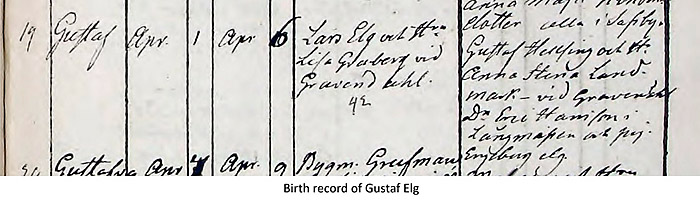

Birth record of Gustaf Elg1834
(source Arkiv Digital )

Gustaf Elg was born on April 1, 1834, the youngest son of Lars Elg (b 1789) and Lisa Gråberg (b 1792). I am descended from their oldest son, Petter Elg, so this is where we are related.

Gustaf Hellsing, who is listed with his wife as godparents, was a nephew of Lars Elg’s stepmother Kristina Berg, and also a fellow blacksmith. I have not been able to identify the third person, but Engelborg Elg is Lars Elg’s half sister.


Lars Elg family 1825-1834
(source Arkiv Digital )

This record shows the family Gustaf Elg was born into. At this time, my ancestor Peter Elg, who is 20 years older, has already left home (his name is crossed over). Another record shows that Peter is now an apprentice with blacksmith Peter Hellsing – father of the Gustaf Hellsing mentioned above.


Birth record of Maria Sophia Bork, 1838
(source Arkiv Digital )

Godparents, master blacksmith Johan Geschwind and his wife Eva Liljman are next door neighbours of the Peter Bork family. Nils Bork is a cousin of Peter. Anna Maria Bork is most likely another cousin.


Peter Bork family 1838-1844
(source Arkiv Digital )

Peter is listed as “hammarsmedsmästare” which means he was in charge of a team operating a hammer mill. (Large waterpowered hammers were used not only to shape the metal but also to alter its metallurgical structure). As a master, Peter employed his own assistants, as well as providing room and board for them. This explains the number of helpers (“drängar”) listed in the record. And with such a large household to run, Lisa also need a number of helpers (“pigor”) to run the household. Note that one of these is Johanna Liljman, no doubt an unmarried sister – or cousin – of godmother Eva Liljman.


Lars Elg family 1845-1854
(source Arkiv Digital )

During this period, the last children are moving out. At age 15, Gustaf moves to Liljendal. His older brother Lars Elg (jr) has moved back with his family, apparently preparing to take over the family business ( Lars sr dies in 1851). There is a long list of helpers, but the mobility is high (column “Ankom” lists year of arrival and place of origin, column “Bortflyttad” lists year of moving out, as well as destination).


Johan Elg family 1845-51
(source Arkiv Digital )

Here we can see that when Gustaf moved to Liljendal at age 15, it was to live with his older brother Johan Elg (b 1817) who is already established as a blacksmith, with a large family. This was Gustaf’s first step in learning the trade and following in the footsteps of a number of ancestors.

He is living close to his future wife: The Bork family are on page 130, and the Johan Elg family on page 134 of the same volume.

Note that another Gustaf Elg (b. 1825) has preceded him in the household as a helper, between 1842 and 1845. This Gustaf was a cousin of Johan and “our” Gustaf Elg.


Peter (or Petter) Bork family 1847-1851
(source Arkiv Digital )

In a serious blow to the family, master blacksmith Peter Bork dies in 1851, aged only 39 years. Maria Sophia is only 13 at the time. We can also see that two younger brother have died in childhood, Carl Johan (age 7) and Anders Fredrik (age 1).


Johan Elg family 1852-57
(source Arkiv Digital )

After three years with his older brother, in 1852 Gustaf Elg moves to Gåsborn parish.

We can also see that the following year, Johan Elg’s wife Cajsa Håkandotter passes away, in December 1853. Johan eventually married again, to Anna Stina Olsdotter, in Jan. 1857. An interesting point here is that there is no mention of this marriage in this volume, but the first child, Reinhold, is listed, born in June 1857. In total there were seven children from Johan’s second marriage. Only the youngest daughter stayed in Sweden. One daughter died in infancy, four emigrated to Butte, Montana, where they were involved in gold mining. The oldest, Reinhold, moved to Oslo, Norway. This was a popular departure point for emigrants from their part of Sweden, and it is possible that Reinhold was planning to join his siblings in Montana. However, his first wife died in Norway. Eventually he marries a Norwegian girl, and the last record I have found shows in as a day labourer, doing construction work in Oslo.


Peter Elg family 1846-55
(source Arkiv Digital )

When Gustaf Elg left Liljendal for Gåsborn parish, he becomes an apprentice with his older brother Peter/Petter Elg (b. 1814), who is then a master blacksmith at Gustavsström, Gåsborn parish. Petter is my paternal great-great-grandfather, and when Gustaf arrives, my great-grandfather Karl Gustaf Elg is a nine year old boy. This is the closest direct connection I have found between the two family lines. Gustaf stays two years with his brother, and then returns to Liljendal.


Marriage record Gustaf Elg & Maria Sophia Bork 1856
(source Arkiv Digital )

Two years after his return to Liljendal, Gustaf is ready to marry Maria Sophia Bork. Gustaf is only 22 at the time and Maria Sophia is 18. In order to marry, Gustaf needed to be able to provide for a family, and their young ages indicate that he was well on his way to establish himself as a blacksmith. At the time, most men were not able to marry until in their thirties.


Gustaf Elg family 1857
(source Arkiv Digital )

In the next household examination record, Gustaf is listed as “mästersven” or assistant master blacksmith, already at 23. The first child, Emma Elisabet is born in 1857.

Apparently, Gustaf has taken over this post from Maria Sophia’s stepfather. The listing at the top of the page shows Maria Sophia’s mother Lisa Stålberg, and her siblings. Lisa is now remarried to assistant master blacksmith Olof Jonsson Rot, but they moved out in 1856, the year of Gustaf’s and Maria Sophia’s marriage.

-oOo-

The family of Gustaf Elg and Maria Sophia Bork is now established, and Gustaf is well on his way to become a master blacksmith. In a following article, I will continue this story, until their emigration to Minnesota in 1892.